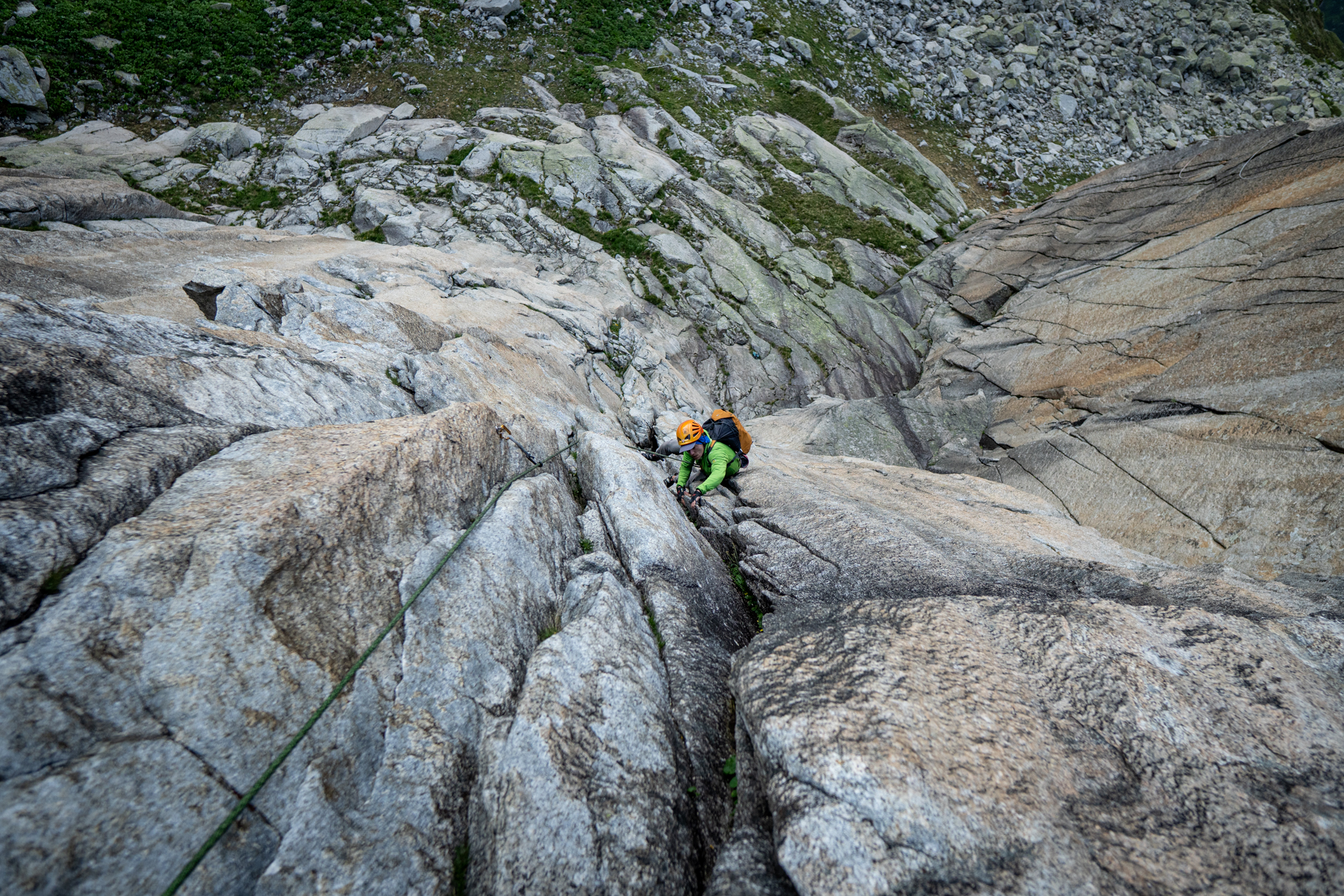
The Salbit massif is one of the most spectacular granite climbing areas in Switzerland. Its crown jewel is the legendary Salbit Westgrat – a 36-pitch alpine ridge leading to the striking summit needle of Salbitschijen (2985 m).

I first saw a photo of this iconic spire years ago in the Schweiz Plaisir guidebook and immediately knew I wanted to climb it someday. That finally happened during a recent long weekend. Below you’ll find a short trip report along with practical information for climbing in the Salbit area.
Logistics & Access
The Salbit massif rises above the narrow Göschenental valley. Access is straightforward – turn west just before entering the Gotthard Road Tunnel, then follow a scenic road for a few kilometers to one of the two parking areas that serve as trailheads for the approach to Salbithütte.
Approach to Salbithütte & Salbitschijen Bivouac
- Reaching Salbithütte involves approximately 1000 meters of elevation gain, typically taking around 1.5 hours on a steep but well-marked trail.
- Continuing to the Salbitschijenbiwak requires another hour of hiking and 400 meters of ascent. The bivouac sits directly beneath the West Ridge – and getting there includes crossing a spectacular suspension bridge.

The Salbitschijenbiwak offers 10 sleeping places, blankets and stove. Reservations are mandatory via the alpine hut booking system, with payment by bank transfer (approx. €18 per person/night in 2025).
⚠️ There is no water source near the bivouac – carry enough from Salbithütte (a large soft flask works very well).

⚠️ Wild camping in the Göschenental valley is strictly prohibited and fined.
Climbing in the Salbit Area
Geier – 6a+, 250 m
Due to unstable weather, we decided to skip the West Ridge and start with Geier Route – a shorter line beginning right below the bivouac and finishing on the first tower. It’s an excellent warm-up climb on impeccable granite.

The opening moves immediately test your footwork, especially with moisture left on the rock from morning fog. But as confidence in friction builds, movement becomes more fluid – through cracks and corners that remain slightly damp. After 7 pitches, we reached the top of the tower and rappelled back to the bivouac.
With time to spare and no rain yet, we hiked down to the hut for food and to refill water – arriving just before a heavy downpour. Rösti and a local non-alcoholic cider made for a perfect alpine lunch. A short weather window later allowed us to return dry to the bivouac for another night.
Clog and Stock – 6a+, 550 m
The next day we set off for a true classic: Clog and Stock – a 550-meter route leading to the summit of Salbitschijen.

From the bivouac, descend briefly toward the hut, pass the South Ridge, and leave gear near a large boulder before following a path toward the wall. The route is easy to identify thanks to a painted “Clog” marking.
A short snowfield guards the base—we crossed it by kicking steps with a rock. A bolt just above the snow made changing into climbing shoes much easier.

The first pitch quickly proved more serious than expected – definitely harder than the 4b indicated in older topos. The next pitches confirmed it: grades in Salbit are solid.

Higher up, the climbing eases, leading through grassy ledges into a corner system climbed over five pitches. A slightly awkward traverse across a snow-filled couloir follows, before more corner climbing leads to the upper ridge.

The ridge is easy but it requires doing short pitches. After a longer while we reach the summit spire.
Salbitschijen Summit Spire
The final summit spire looks intimidating: a diagonal traverse along a sharp edge, with friction footwork and minimal protection (a single piton about 3 meters above the belay).
In reality, the climbing is surprisingly manageable – and the summit view makes every step worth it.

Descent from Salbitschijen
The descent follows a path marked with red signs. It is sometimes exposed, pretty loose and easy lose, especially in the dark . Plan your climb to descend in daylight. Beow you will fund my GPS track (GPX) which can be very helpful.
The most exposed sections are protected with fixed steel cables. Early in the season, snow patches may require crampons and an ice axe. We descended comfortably in approach shoes, using a trekking pole for balance.
Climb Salbit with an IFMGA Mountain Guide
Salbit offers some of the finest granite routes in Switzerland. If you’re dreaming of climbing the Salbit Westgrat or the Salbit Südgrat, consider going with a certified IFMGA guide.
As an IFMGA/UIAGM/IVBV mountain guide, I can organize a safe and fully legal climbing experience in this exceptional alpine area.
📩 Have questions? You can use the contact form on the main page or write an email on booking@ivbvguide.com.